
5 questions for Falk Möller on ZUKUNFT PERSONAL EUROPE
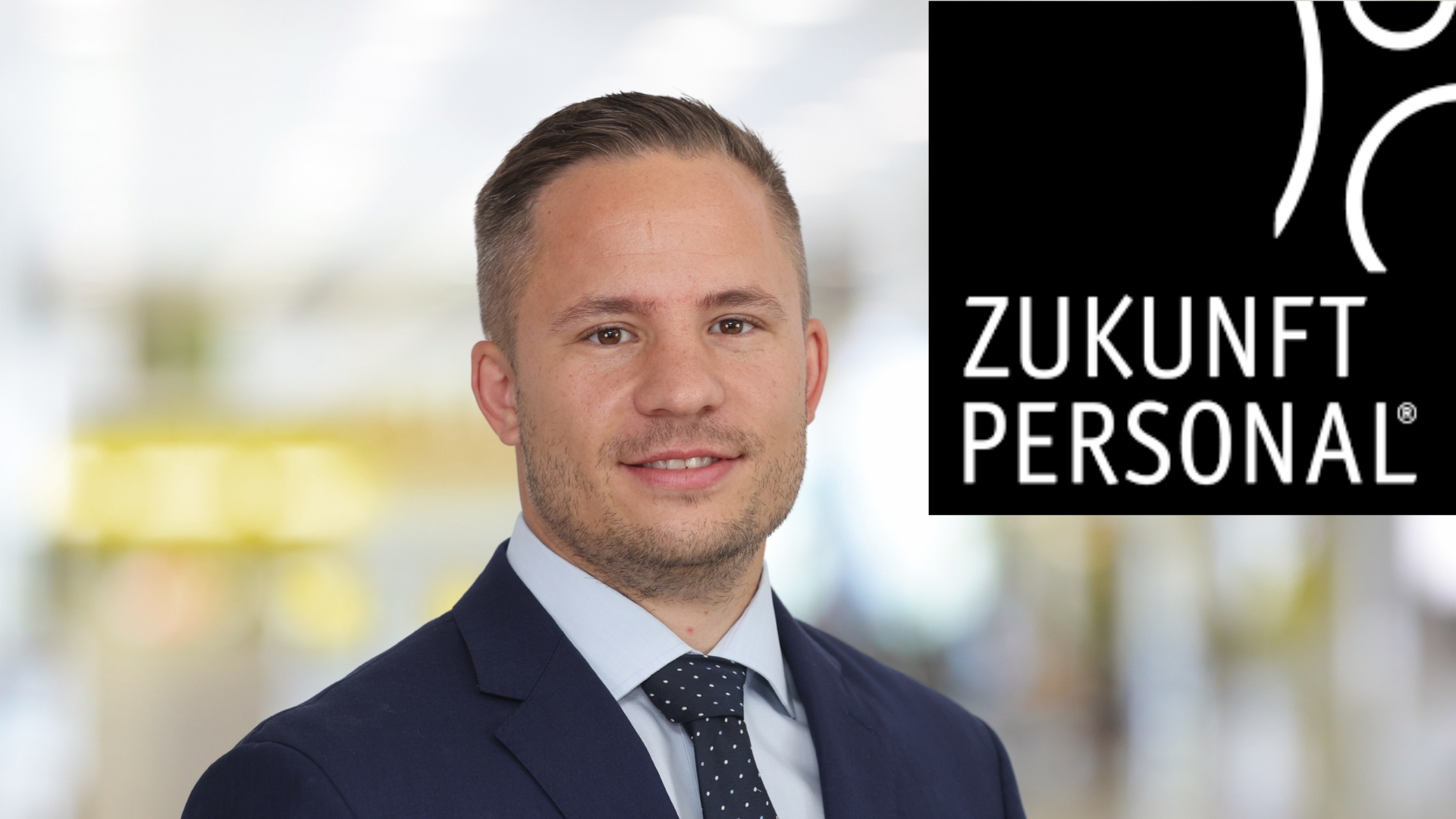
Photo: Falk Möller (Managing Director | LÖSUNG N GmbH)
The Zukunft Personal Europe conference is currently bringing the HR community together in Cologne. Falk Möller, Managing Director of LÖSUNG|N, is there in person. In this interview, you’ll find out why he’s travelling there, what LÖSUNG|N has to do with HR, and what was the most unusual question he was ever asked as a recruitment manager during a job interview, amongst other things. Enjoy the read!
.
LÖSUNG|N is not known as a traditional recruitment consultancy. Why are you attending this trade fair?
For me, the trade fair is exciting for two reasons.
Firstly, there are many relevant topics here relating to workplace health management, exercise and prevention. This is also important for us as an employer. One of our partners, with whom we jointly develop programmes for our staff, is also here. Naturally, I’m keen to see what new ideas and approaches are on offer.
Secondly, we regularly encounter HR topics in our consultancy projects. We support companies in selecting and implementing HR solutions, in the digitalisation of HR processes, and in cross-organisational transformation projects.
And even if a project doesn’t appear to be an HR project at first glance, HR often plays a central role. After all, many processes in an employee’s career lifecycle – from joining the company, through changes in role, to leaving – begin precisely there.
Do you have any examples from day-to-day project work?
They vary greatly. Three examples illustrate quite well just how broad the topic actually is.
For instance, we designed and implemented a Security Operations Centre (SOC) in combination with a SIEM solution. When people hear ‘SOC’, many initially think of technology, cybersecurity and tools. However, we give just as much thought to who responds to a critical alarm at three o’clock in the morning. Suddenly, it’s also about shift patterns, on-call arrangements, available specialist staff, working time regulations and, where applicable, collective agreements. Even the best technology is of little use if the operational model behind it doesn’t work.
Another example is Identity & Access Management. Here, the HR system is often the central source for employee master data. An employee’s joining, transfer or leaving the organisation then automatically triggers authorisations and processes across numerous IT systems. As a result, what starts out as a supposedly technical IAM project very quickly becomes an HR process project as well.
And then, of course, there are the classic HR digitalisation topics: workforce management, digital personnel files, electronic signatures and the end-to-end digitalisation of HR processes.
The exciting thing about this is that HR and IT can hardly be viewed separately these days.
In your view, what is the most important trend in the field of HR?
Of course, there’s no getting round artificial intelligence at the moment. And I genuinely believe that AI will fundamentally transform the world of work.
In my view, this is less about entire job roles suddenly disappearing. More often than not, it’s about tasks changing. Routine tasks are being automated, knowledge becomes available more quickly, and staff can focus more on evaluation, communication and decision-making.
At the same time, we’re seeing a significant discrepancy in many organisations: expectations of AI are enormous, but putting it into practice is often still difficult. In the public sector in particular, data protection, information security, employee participation, regulation and a lack of practical experience play a major role.
We are therefore engaging very intensively with this topic ourselves. We have established internal structures, are deliberately experimenting with new applications and are systematically investing in further training. Our consultants naturally then bring this knowledge to bear in their projects.
For HR, I believe this means one thing above all: competence management is becoming even more important. The question is no longer just: ‘What roles do we need?’, but increasingly: ‘What skills will our employees need tomorrow?’
What do you think of New Work?
I don’t think much of buzzwords, but I do think highly of what ‘New Work’ actually stands for.
For me, ‘New Work’ doesn’t automatically mean working from home, lounge furniture or a table football table. It means organising work in such a way that people can be productive, take on responsibility and make the best possible use of their strengths.
As an employer, this raises a very simple question for us: how do we create conditions in which very good people enjoy working for us whilst also being able to develop professionally?
This can be in the office, whilst working from home, or even on the move at a client’s premises. For me, it’s not so much the place of work that matters as the combination of trust, responsibility, good working conditions and a strong team.
Incidentally, we do actually have lounge furniture and home office facilities. The only thing missing is the obligatory table football table. Instead, we have a table tennis table.
You’re a recruitment manager yourself. What was the most unusual question you’ve ever been asked in a job interview?
A candidate once asked me:
“Can I bring my dog along now and then?”
So?
Of course.
We now even have several L|N Dogs on the team. And to be perfectly honest: they’ve been extremely well received by our colleagues.
Professional expertise is, of course, important to us – but a bit of four-legged support in the office can’t do any harm either.
Thank you very much for the interview.